A travel card and a cash exchange counter can both help you manage money in Phu Quoc, but they solve different problems. A travel card gives you access to money already held in an account or wallet; a cash exchange counter converts the foreign banknotes you physically carry into Vietnamese Dong (VND).
Start with the money you already have
Before comparing costs, identify your starting point. If your money is mainly in a bank account or travel card, your practical choices are merchant card payments and ATM withdrawals. If your money is already in USD, EUR, AUD, KRW or another foreign currency as cash, a physical exchange transaction may be the more direct route.
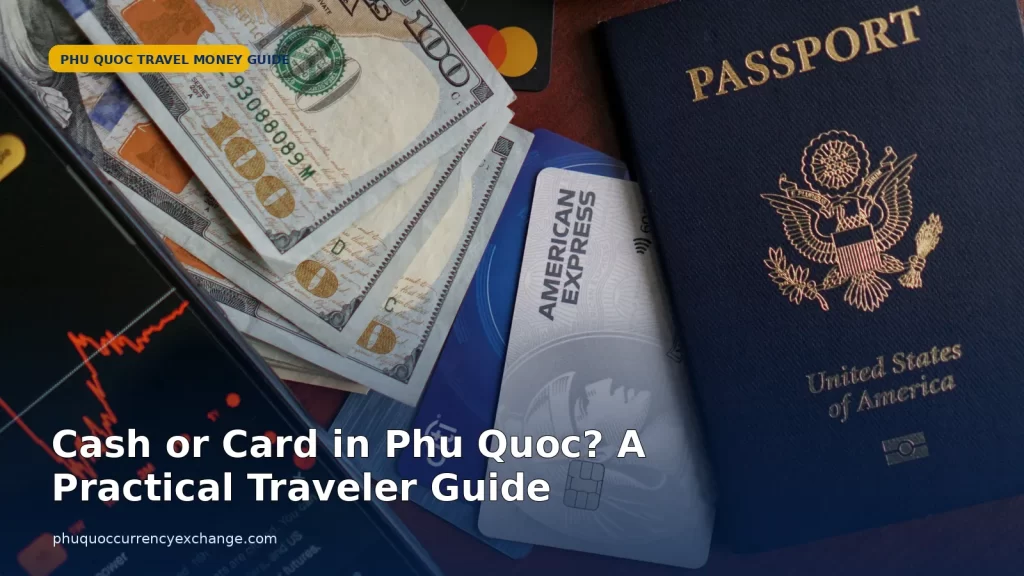
The Cash or Card in Phu Quoc? guide explains how the payment decision differs from the question of how you obtain VND.
Travel card vs cash exchange at a glance
| Factor | Travel card | Cash exchange |
|---|---|---|
| What you need | A working card/account and merchant or ATM access. | Physical foreign banknotes accepted by the provider. |
| Main cost to compare | Card-provider conversion terms, ATM fees, issuer fees and any merchant charges. | Cash buy rate, spread and any separate fee or adjustment. |
| Main practical limit | Card acceptance, ATM limits, account controls and card availability. | Currency, note denomination, series, condition and current cash availability. |
| Security profile | Less need to carry foreign cash, but card loss or blocking can interrupt access. | No card dependency, but you must physically protect the cash you carry. |
When a travel card can fit well
Vietnam Tourism notes that international debit and credit cards are generally accepted at many hotels, tour operators, restaurants, boutiques, grocery stores and spas. For travelers staying mainly in established tourism businesses, that can reduce the amount of cash you need to carry.
A travel card can also be useful for ATM withdrawals, but the final cost depends on more than the card provider’s advertised exchange rate. Check ATM operator fees, your provider’s own withdrawal rules, limits and any conversion choice shown on the machine.
For ATM-specific planning, use the Phu Quoc ATM Guide.
When cash exchange can fit well
If you already carry foreign banknotes, cash exchange lets you convert those notes directly into VND without first moving money through an ATM. The key inputs are the current buy rate, any separate fee, the physical notes you hold and the final VND you are offered.
Check the published exchange rates and use the rate comparison guide to compare like-for-like quotes.
Do not compare only the advertised exchange rate
A travel card may advertise a competitive conversion rate but still involve ATM fees, withdrawal limits or card-provider rules. A cash exchange counter may display a simple rate but still require you to confirm whether a separate fee or banknote adjustment applies.
Compare the amount of VND you actually receive or the total VND cost of the card transaction. The spread vs fees guide helps separate rate differences from separate charges.
Watch for Dynamic Currency Conversion
When you pay by card or use an ATM, you may be offered a choice between VND and your home billing currency. This is often called Dynamic Currency Conversion, or DCC. The convenient-looking home-currency amount is not automatically the cheaper option.
Before accepting any conversion, check the exchange rate, any markup or extra fee, and what your own card provider would otherwise charge. For the full decision, read Dynamic Currency Conversion in Phu Quoc: Pay in VND or Your Home Currency?.
Travel card access can fail even when your balance is fine
A card can be blocked by your issuer, rejected by a particular merchant or limited by an ATM. That does not mean travel cards are unreliable; it means one payment method should not be your only fallback.
Keep a second card or modest cash reserve separately where practical. The Currency Exchange Safety Checklist covers the broader backup and cash-security routine.
Cash exchange has its own operational friction
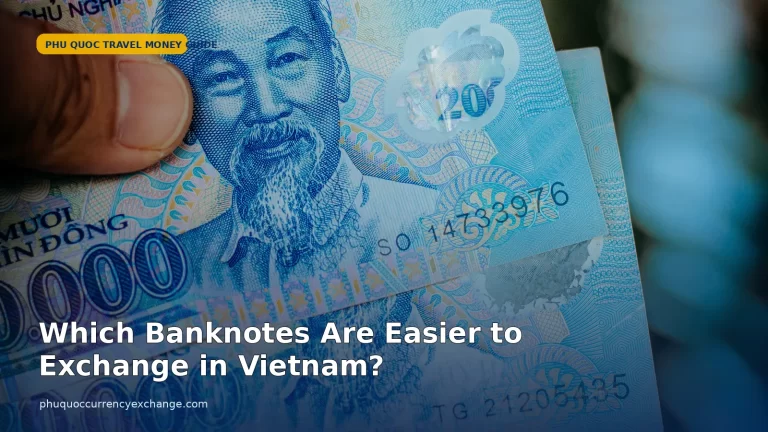
Foreign banknotes can be refused or require extra checking because of series, denomination, writing, tears, stains or other condition issues. A rate table cannot guarantee acceptance of every physical note.
Before carrying a larger amount to a counter, check the Banknote Guide. If the transaction is important or large, confirm it first rather than relying on a general rate page.
Which option works better for a large amount?
Neither method should be assumed to be better solely because the amount is larger. A travel card may run into ATM or account limits; a cash exchange may need advance confirmation of rate, VND availability, timing and required information.
For that planning step, use Exchanging a Larger Amount of Cash in Phu Quoc: What to Confirm First.
Use a mixed strategy instead of forcing one winner
A practical travel-money setup can combine a card for larger card-friendly expenses, VND cash for small or cash-preferred purchases, and a foreign-cash reserve if that suits your trip. The exact split depends on your itinerary and risk tolerance.
The goal is not to use every payment method. It is to avoid carrying unnecessary cash while also avoiding dependence on one card or one machine.
Travel card vs cash exchange checklist
- What form is your money in now: account balance or physical foreign cash?
- Which merchants on your itinerary are likely to accept cards?
- What does your card provider charge for foreign transactions and ATM withdrawals?
- What fees does the ATM operator show?
- Are you being offered Dynamic Currency Conversion?
- What is the current cash exchange quote for the notes you carry?
- Are your banknotes in acceptable condition?
- Do you have a backup if the card or cash route fails?
Continue your Phu Quoc travel-money plan
If your choice is specifically ATM versus cash exchange, use ATM vs Currency Exchange in Phu Quoc. If you are still deciding what foreign cash to carry, read Should You Bring USD or Your Home Currency to Phu Quoc?.
Official references: Vietnam Tourism states that VND is the official currency, cash remains useful for smaller purchases and many established travel businesses accept international cards. Visa explains that DCC can be offered at merchants and ATMs and should disclose the exchange rate and any additional fees or markup before the cardholder chooses whether to accept it. Vietnam Tourism currency guide → Visa DCC guide →