When you pay by card or withdraw cash from an ATM in Phu Quoc, the screen may offer to convert the transaction into your home billing currency instead of processing it in Vietnamese Dong (VND). That service is called Dynamic Currency Conversion, or DCC.
Quick answer: do not choose your home currency automatically because the amount looks familiar. Read the DCC exchange rate, markup or fee, then compare that offer with the costs that apply if the transaction stays in VND.
Official-source check: 22 September 2026. Visa’s current traveler guidance and Mastercard’s 2025 DCC performance guide both require a genuine cardholder choice rather than automatic DCC.
What DCC changes
If you keep the transaction in VND, your card issuer or network applies its own foreign-exchange terms according to your card agreement. If you accept DCC, the merchant or ATM side converts the VND amount into your billing currency before the transaction is processed.
Decision flow when a terminal or ATM offers your home currency
- Find the amount in VND.
- Find the amount in your billing/home currency.
- Check the exchange rate used for the conversion.
- Check any additional fee or markup.
- Compare that offer with your own card issuer’s foreign-exchange and transaction fees.
- Choose only after you understand which party will perform the conversion.
If you want to avoid the ATM or merchant’s DCC conversion, choose VND / local currency when that option is clearly presented. Your own issuer can still charge foreign-transaction or ATM fees.
What Visa says should be shown
Visa says merchants and ATMs offering DCC should clearly display the purchase or withdrawal amount in local and cardholder currency, both currency symbols, the exchange rate used and any additional fee or markup. Visa also says the merchant or ATM should give the cardholder the choice to accept or decline the conversion and must not choose on the cardholder’s behalf.
Visa — Dynamic Currency Conversion
What Mastercard says about choice
Mastercard’s DCC guidance states that the cardholder must be clearly advised of the option to complete the transaction in either local currency or billing currency, and that DCC must not be applied without the cardholder’s consent. The currency options should be presented neutrally rather than steering the cardholder toward DCC.
Mastercard — Dynamic Currency Conversion Performance Guide
DCC at an ATM
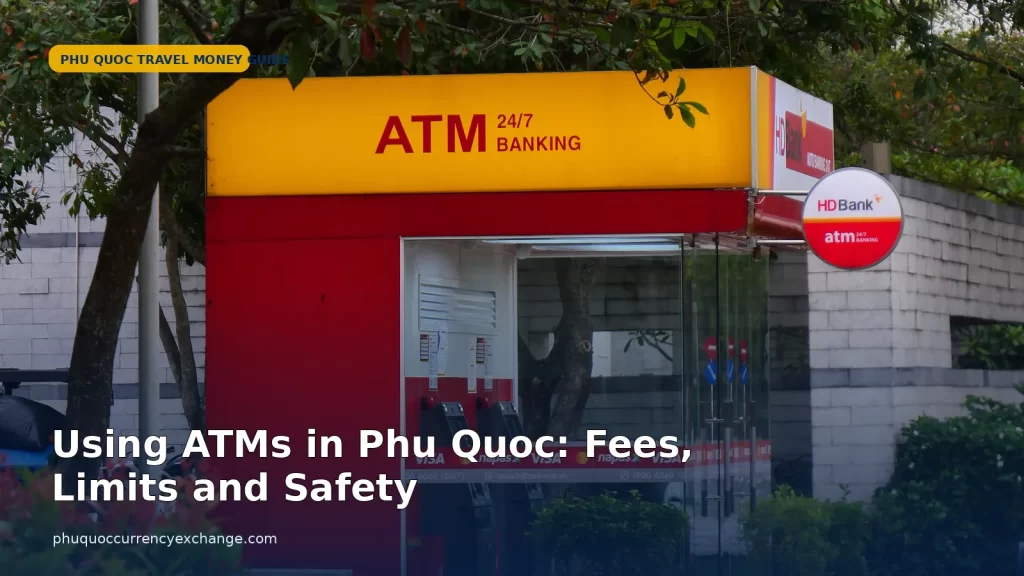
An ATM operator surcharge and DCC are separate costs. Declining DCC does not necessarily remove the ATM’s own withdrawal fee, and your card issuer can also add a separate ATM or foreign-transaction fee.
Use the Phu Quoc ATM Guide for local ATM leads, current operator-fee examples, withdrawal limits and retained-card planning.
DCC at a hotel, restaurant or shop
A merchant terminal can make the same home-currency offer during a card purchase. If both VND and your home currency are displayed, read the rate and markup before confirming. Do not let a cashier or terminal workflow make the choice without your understanding.
For the broader payment plan, read Cash or Card in Phu Quoc?.
Does choosing VND guarantee the cheapest result?
No. Choosing VND avoids the merchant or ATM’s DCC conversion, but your own card issuer still applies its exchange-rate and fee terms. The fair comparison is the complete cost of each route, not “DCC bad, VND always good.”
- DCC route: DCC rate + DCC markup/fee + any separate ATM or merchant charge.
- VND route: issuer/network conversion + your card’s foreign-transaction fee + any separate ATM or merchant charge.
If the screen does not give a clear choice
If the required rate/fee information is missing, the options are unclear or you feel pressured toward one currency, do not approve a conversion you do not understand. Visa advises cardholders to decline the DCC offer and report problems to the card issuer when appropriate.
DCC checklist
- Local VND amount visible
- Billing-currency amount visible
- Exchange rate visible
- Markup or additional fee visible
- Separate ATM/merchant charge understood
- Genuine accept/decline choice
- Your own issuer terms checked
- Receipt or transaction record retained until the charge is verified
Freshness note: DCC rules, terminal implementations and card-provider fees can change. This page records the source-check date; your issuer’s current terms and the information shown on the terminal remain part of the actual transaction decision.