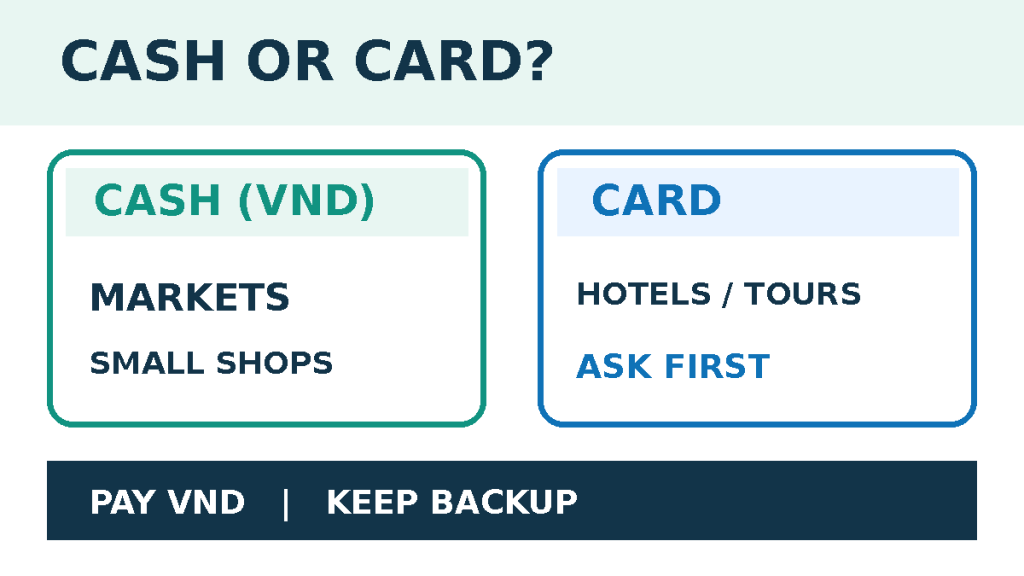
For most Phu Quoc trips, you do not have to choose only cash or only a card. Keep some Vietnamese dong (VND) for small purchases and places that prefer cash, then use your debit or credit card where the merchant confirms it is accepted. A backup payment method can help if a terminal fails or your card is declined.
Quick answer: For a street stall or small local purchase, be ready with VND notes. For a hotel, resort or organised tour, ask about card payment and any conditions before relying on it. At a card terminal, read the currency choice and conversion terms before approving. No single payment method works at every business.
Cash or card? A quick choice by expense
Vietnam Tourism’s official payment guide describes cash as common for street vendors and smaller purchases, while many established hotels, restaurants and tour operators accept international cards. This is national guidance, not a verified card-acceptance list of individual businesses in Phu Quoc. The easiest decision is to ask each seller before ordering or booking.
| What you plan to pay for | Practical starting choice | Check before you pay |
|---|---|---|
| Market or street-food stall | Have smaller VND notes ready | Ask if they take cards or only cash. |
| Café or restaurant | Cash or card may work | Confirm your card network and the final total. |
| Hotel or resort | Card can be convenient | Check whether the bill is prepaid, deposits and payment currency. |
| Organised tour or attraction | Follow the booking terms | Check prepayment versus pay-on-arrival and card support. |
| Taxi, driver or local transfer | Confirm directly, carry a VND fallback | Do not assume all independent operators have card terminals. |
| Remote or small-business outing | Plan some cash before leaving | Cash and ATM availability may be limited; verify locally. |
The right choice can change from one stop to the next. You can use a card for a confirmed hotel bill and cash later for small purchases without needing to carry every day’s spending in your wallet.
Three common travel situations
- Mostly prepaid resort stay: If accommodation, transfers and major activities are already paid for, keep a modest amount of VND for meals, tips where appropriate, small shops and backup. Use your card where acceptance is confirmed; there is no reason to automatically exchange the full trip budget.
- Mixed island itinerary: A day of restaurants, tours, markets and transport may call for both methods. Separate confirmed card payments from cash-only or uncertain ones, then decide how much VND you will need before your next reliable top-up.
- Cash-heavy day: For local markets or remote activities, prepare more working cash for that outing, not necessarily for the entire holiday. Carry your notes securely and keep another payment option available when practical.
To turn these situations into an actual amount of money, see How Much Cash Should You Carry in Phu Quoc?. This guide focuses on how to pay; it does not invent current meal prices or a universal daily cash budget.
Paying by card: check VND versus your home currency
When a merchant’s card terminal offers to charge you in your home currency instead of VND, it may be offering Dynamic Currency Conversion (DCC). The offer can include an exchange rate and extra markup. Visa’s official DCC guidance says the merchant should show both amounts, the rate and any fees, and you should be free to accept or decline the conversion.
For most travelers, choosing VND rather than the terminal’s home-currency conversion is a sensible starting point because it avoids accepting that merchant’s DCC markup. However, your card issuer may still charge a foreign-transaction fee and determine the final conversion rate. Mastercard’s currency converter explains why network estimates and the amount your bank eventually bills can differ.
Before approving a card payment, check the transaction amount, selected currency and any displayed fees. If the screen or the staff does not offer a clear currency choice, ask for clarification. The DCC Guide for Phu Quoc explains this specific decision in detail.
Card purchases, ATM withdrawals and foreign cash are different
| Action | What you are doing | Main costs or checks |
|---|---|---|
| Pay a merchant by card | Your issuer settles a purchase | Merchant card acceptance, purchase currency, possible issuer fee and DCC choice. |
| Withdraw VND from an ATM | Access cash from a card-linked account | ATM operator fee, issuer fee, withdrawal limit and possible DCC. |
| Exchange foreign banknotes | Give physical foreign cash to receive VND | Actual cash-buying quotation, note condition, any charges and final VND. |
These are not interchangeable costs. A card purchase is not automatically an ATM cash advance. A credit-card ATM withdrawal, unlike an ordinary purchase, may be treated as a cash advance with different fees or interest. Refer to Using ATMs in Phu Quoc for withdrawal specifics and Travel Card vs Cash Exchange for choosing how to obtain VND rather than how to pay a merchant.
If you already have USD, EUR or other physical notes and want VND, use How to Exchange Money in Phu Quoc and check the Banknote Guide. An exchange rate on a website is not a guaranteed quote or proof that a listed provider can perform every transaction.
Keep a small cash fallback without carrying too much
A simple approach is to keep working VND notes in your day wallet and a backup card or reserve amount in a separate safe place. Make sure your card can be used internationally, know your issuer’s travel requirements and check whether you may face a transaction limit. Visa’s travel advice recommends checking card details before a trip.
If one merchant cannot accept your card, ask whether there is another payment method before committing to a purchase. If your card stops working, use your backup rather than repeatedly trying an unfamiliar terminal. For cash, learn the common VND denominations in the Vietnamese Dong Guide to avoid confusing similarly coloured notes.
A 5-step check before paying
- 1. Ask: Does this specific seller accept your card, or should you pay in VND cash?
- 2. Confirm: What is the final price, and has any part already been prepaid?
- 3. Check the currency: If paying by card, read the VND/home-currency choice and any DCC markup before approving.
- 4. Keep a fallback: Ensure you still have enough VND or a working second payment method for the next stop.
- 5. Verify: Check the terminal total or cash change and keep the receipt if provided.
Frequently asked questions
Can I use an international credit or debit card everywhere in Phu Quoc?
No. Many established businesses may accept cards, but you must confirm with the individual merchant. Keep VND for small or uncertain purchases.
Should I always accept a payment terminal’s amount in my home currency?
No. That may be DCC with an added markup. Review the disclosed rate and fees; declining DCC and paying in VND often avoids the merchant’s conversion markup, though card-issuer fees may remain.
Is paying by card the same as withdrawing cash from an ATM?
No. A card purchase, debit-card cash withdrawal and credit-card cash advance have different rules and potential fees. Check the transaction type and your issuer’s terms.
How much VND should I carry if I mostly use cards?
Enough for the cash-only and uncertain purchases before your next dependable way to get more VND, plus a personal buffer. Use the separate cash-planning guide rather than a fixed amount.
Sources reviewed 26 October 2026: Vietnam Tourism — Currency and Payments, Visa — Dynamic Currency Conversion, Mastercard — Currency Converter and Visa — Travel. Card acceptance, terminal policies, issuer charges and ATM availability can change. Ask the merchant and your card issuer when a specific transaction depends on them. For the broader travel plan, use the Phu Quoc Travel Money Guide.