An exchange-rate spread and a separate fee both affect your money, but they are not the same thing. For travelers changing foreign banknotes into Vietnamese dong (VND), the useful question is: How many VND will I receive after any charges?
Quick answer: A spread is the difference between a provider’s buying and selling exchange rates. A fee or commission is an extra charge, if one applies. Compare the final VND for the same cash amount and note condition, not just a headline rate or a “no commission” sign.
Spread vs fee: what is the difference?
| Term | Simple meaning | What you should check |
|---|---|---|
| Exchange-rate spread | The gap between the provider’s buy and sell prices for a currency. | Which cash-buying rate applies to the foreign notes you hand over. |
| Separate fee / commission | A charge added or deducted separately from the quoted conversion rate, if applicable. | How much VND is deducted or what amount you must pay. |
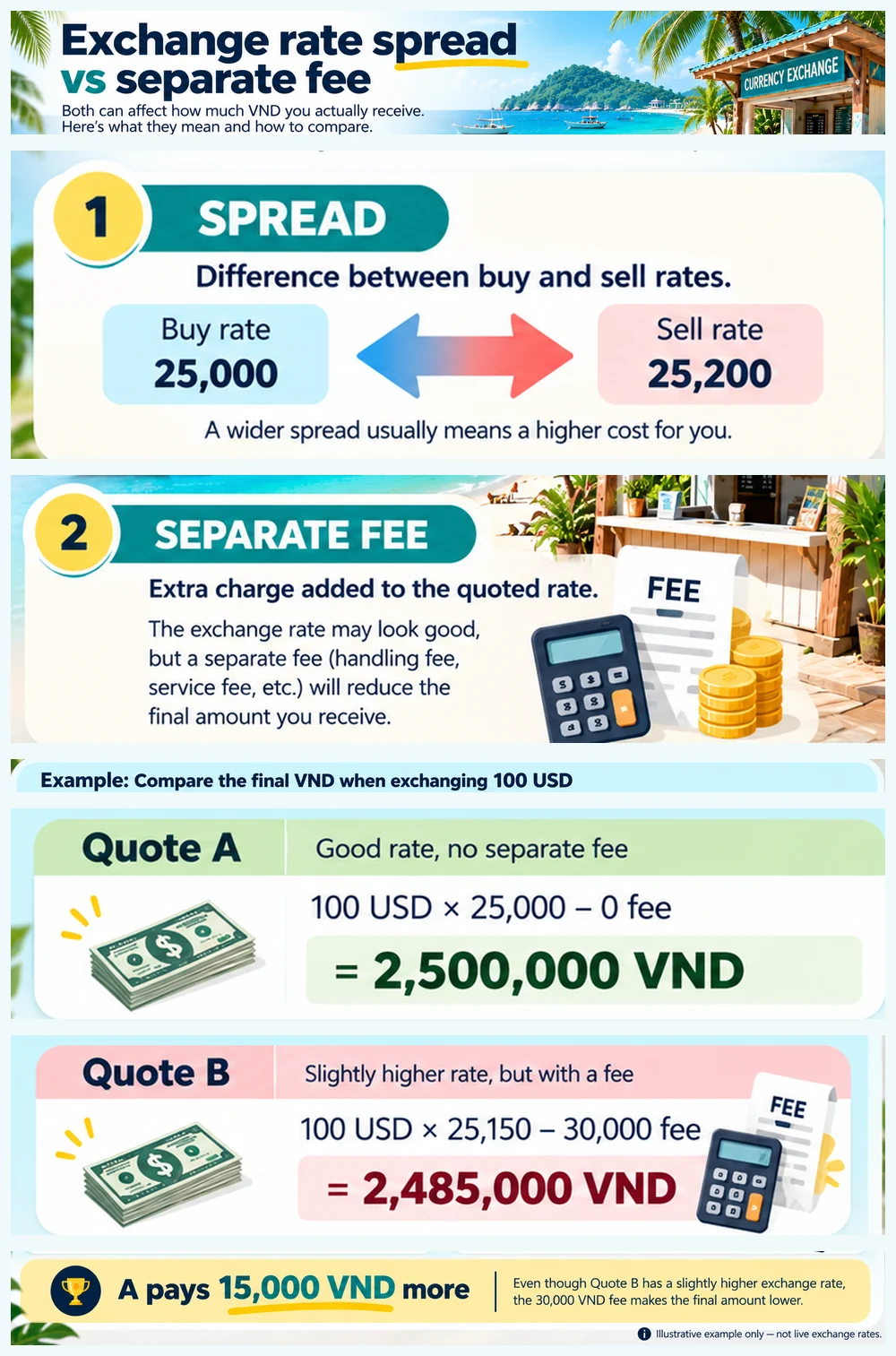
For example, if a provider lists a USD buy rate of 25,000 VND and a sell rate of 25,200 VND, the displayed difference is 200 VND per USD. That does not mean a traveler selling USD necessarily pays a separate 200 VND fee for each dollar. The applicable buy rate determines the cash-exchange calculation.
New to “We Buy” and “We Sell”? Start with Buy vs Sell Exchange Rates Explained.
Example: a higher rate can still pay less
These figures are illustrative only. They are not published rates or fees from a real counter. Both offers below are for the same 100 USD cash transaction.
| Comparison | Quote A | Quote B |
|---|---|---|
| Cash given | 100 USD | 100 USD |
| Cash-buying rate | 25,000 VND/USD | 25,150 VND/USD |
| Separate fee | 0 VND | 30,000 VND |
| Final VND received | 2,500,000 VND | 2,485,000 VND |
In this example, Quote A pays 15,000 VND more. Quote B offers the higher headline rate, but its separate fee reduces the money received. The image uses the same numbers so you can check them against the table.
Simple calculation: foreign cash amount × applicable cash-buying rate − any separate VND fee = final VND received. For Quote B: 100 × 25,150 − 30,000 = 2,485,000 VND. If a quote is shown per 100 foreign-currency units rather than per one, adjust the calculation first.
An effective rate lets you compare different fee structures: final VND received ÷ foreign-currency amount. For Quote B, that is 24,850 VND per USD after its fee. See How to Compare Currency Exchange Rates in Phu Quoc for the full side-by-side method.
Does “no commission” mean free exchange?
Not necessarily. “No commission” may mean there is no separately listed fee, while the conversion rate itself can still differ from a market reference rate. The Australian Competition and Consumer Commission advises travelers to compare the total price, including both exchange rates and fees; an offer advertised as fee-free is not automatically the cheapest. Source: ACCC consumer guidance.
Rather than asking only “Do you charge a fee?”, also ask “For my exact amount and notes, how many VND will I get in total?” That answer is more useful than either a rate or an advertising phrase on its own.
ATM and card fees are different from cash exchange spreads
Cash-exchange costs should not be mixed with card or ATM charges. These are different transactions, and the screen or card issuer may disclose different types of fees.
| Cost | Where it may apply | What to check |
|---|---|---|
| Cash exchange spread | Physical banknote conversion | Cash-buying rate and final VND |
| Separate service fee | Some cash exchanges or related services | Fixed or percentage amount, if any |
| ATM operator surcharge | ATM cash withdrawal | Fee displayed at the machine |
| Card issuer fees | Card or overseas ATM use | Your bank’s own fee schedule |
| DCC conversion markup | Optional card-terminal or ATM home-currency conversion | Rate, markup, and choice to accept or decline |
Visa explains that dynamic currency conversion (DCC) is a choice to convert a card purchase or ATM withdrawal into the cardholder’s home currency. It can involve a separate displayed exchange rate and markup; it is not the spread on a physical cash exchange. Source: Visa DCC guidance.
For details, use the Phu Quoc ATM Guide and the DCC Guide. If your decision is ATM versus a cash counter, use ATM vs Currency Exchange.
What else can change the final VND?
- Different banknotes: old, marked or damaged notes may have different acceptance terms. Check the Banknote Guide.
- Different dates or times: a quote from this morning and another from tomorrow are not a fair like-for-like comparison.
- Different transaction direction: a provider buying your foreign cash is not the same as selling you foreign cash.
- Reference versus transaction rate: a published market reference rate does not guarantee the amount a counter will offer.
The European Central Bank says its euro foreign-exchange reference rates are for information, not for executing transactions. To check actual cash terms, use a current quote for the type and condition of banknotes you have.
A quick checklist before exchanging cash
- Confirm the foreign currency, exact amount and cash-buying direction.
- Ask whether a separate fee or commission applies.
- Check that your note denominations and condition are acceptable.
- Request the final VND you will receive.
- Note the time of the quote and reconfirm before making a special trip.
You can check the published exchange-rate information and contact the service to verify which terms apply to your planned transaction. Do not treat a published rate alone as a promise that a specific amount of cash will be available.
Common questions
Is the spread the same as a commission?
No. Spread refers to the difference between the quoted buy and sell rates. Commission is a separate fee, if charged.
Should I always choose the highest cash-buying rate?
No. Check any separate fee and compare the final VND for the same amount and note condition.
Is an ATM surcharge part of the cash-exchange spread?
No. The ATM surcharge is linked to an ATM withdrawal. A cash-exchange spread is the difference between a provider’s buy and sell rates.
Source review: 25 October 2026. This guide explains pricing concepts, not a live exchange quote or evidence of which provider is cheapest. Confirm current rates, fees and banknote requirements before exchanging.