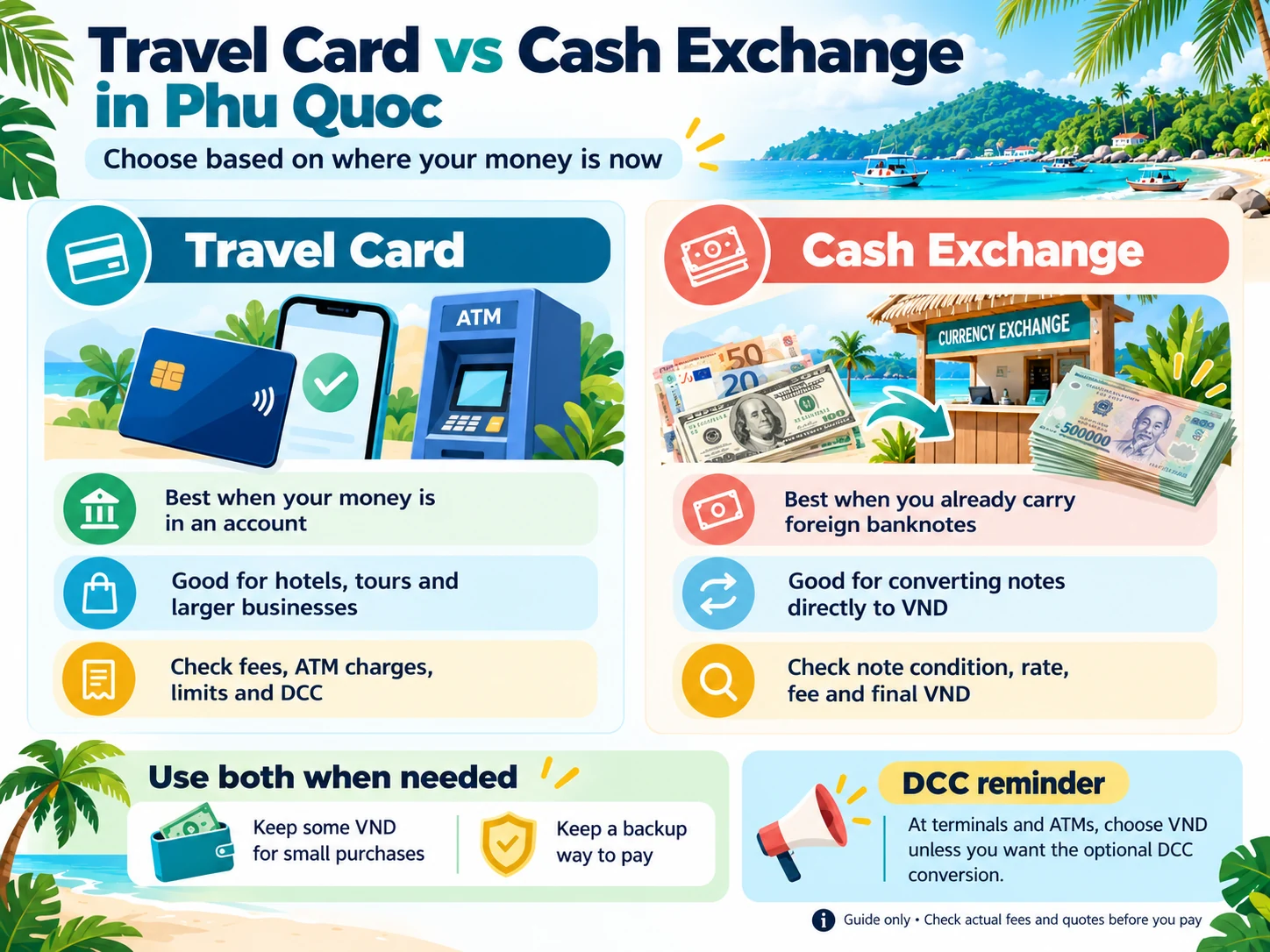
A travel card and a cash exchange counter can both help you pay for a Phu Quoc trip, but they use different money you already have. A travel card or bank card usually spends funds from an account. A cash exchange counter converts foreign banknotes you bring into Vietnamese dong (VND). The best starting point depends on where your money is now, the charges involved and how you plan to pay.
Quick answer: If most of your money is in an account, start with card payments and plan an ATM backup. If you already carry foreign banknotes, compare cash exchange quotes for those notes. In either case, keep enough VND for small purchases and a second way to pay when possible.
First, identify where your travel money is
| Your situation | A sensible starting choice | Check before you use it |
|---|---|---|
| Money is in a travel card or bank account | Pay by card where accepted; withdraw some VND if needed | Your card’s foreign payment fees, exchange rules, ATM limits and local acceptance |
| You already have USD, EUR or other foreign banknotes | Ask for a cash-buying quote to exchange those notes into VND | Accepted currency and notes, rate, separate fee and final VND |
| You have both a card and foreign banknotes | Use each for the expenses it handles best, with one as a backup | The real charges and availability for each method |
Do not treat a travel card and a cash counter as identical ways to spend the same money. If your money is only in an account, bringing additional foreign banknotes just to use a cash counter may create an extra exchange step. If you already hold cash, you do not need an ATM simply to turn those notes into VND.
When using a travel card works well
Card payments can be convenient for hotels, larger restaurants, tours and other businesses that accept your card. Vietnam Tourism says cash remains common for small vendors while many established businesses accept international cards. That is general guidance, not a promise that every place in Phu Quoc takes your card. Check before ordering or booking. Vietnam Tourism’s payment guide explains the national context.
Your card may be a prepaid multi-currency card, a debit card or a credit card. They do not all have the same fees. Look in your card app or agreement for foreign-payment charges, currency conversion, cash withdrawal limits and any fee-free allowance. For example, Wise explains that its ATM fees vary by where the card was issued; its rules are not universal rules for all travel cards.
For a cash withdrawal, an ATM operator can charge a fee in addition to the card provider. The Phu Quoc ATM guide covers operator fees, limits and common problems.
When exchanging the foreign cash you carry works well
If you already have suitable foreign banknotes, ask a counter how much VND you will receive. Check the cash-buying rate, any separate fee and whether the counter accepts your note type, denomination and condition. A published rate is not a guarantee that a particular note or amount will be accepted.
To compare quotes, give different providers the same currency and amount, ask about all charges, and compare the final VND paid out. See How to Compare Currency Exchange Rates and the Banknote Guide. For a larger exchange, call ahead about availability and any required information.
Compare the real costs, not just the advertised rate
| Option | Costs that may apply | What to confirm |
|---|---|---|
| Card purchase | Issuer conversion rate, foreign-transaction charge and optional conversion at the terminal | Amount charged in VND and your bank’s actual conversion terms |
| Card withdrawal at an ATM | ATM operator surcharge, card issuer withdrawal fee, conversion charges and possible DCC | Fee on the machine, issuer fees and how much cash you receive |
| Exchange foreign banknotes | Cash-buying rate, rate difference and any additional fee or adjustment | Final VND for the exact notes and amount you bring |
These are different kinds of transactions. Do not compare a card purchase of 1,000,000 VND with a cash quote for 100 USD and call one cheaper without putting the amounts and conditions on a comparable basis. If you need to understand rate differences and added charges, read Exchange Rate Spread vs Fees.
Card conversion at a terminal or ATM: understand DCC
Some terminals and ATMs offer to convert a VND transaction into your home currency. This is called Dynamic Currency Conversion (DCC). Visa says the offer should show both currency amounts, the exchange rate and any extra fee or markup. You can accept or decline that conversion.
If you want your card issuer or network to handle conversion instead, decline the optional DCC offer and select VND when the screen gives you that choice. This avoids the terminal or ATM’s conversion offer, but does not cancel your bank’s own charges. Read Visa’s DCC explanation and our DCC guide.
Three common situations in Phu Quoc
- Mostly prepaid resort stay: use a card for remaining payments the hotel confirms it accepts, plus a modest amount of VND for smaller or unexpected purchases.
- Markets and independent activities: carry VND for purchases that require cash. If your funds are in an account, check ATM fees before withdrawing; if you already have banknotes, check a cash exchange quote.
- Late arrival or a remote outing: keep a backup payment option ready. Check ATM access and published exchange opening hours before relying on either one.
The decision about what to pay with is slightly different from the decision about how to get VND. For everyday purchases, use Cash or Card in Phu Quoc?; for an ATM withdrawal versus exchanging your notes, use ATM vs Currency Exchange.
Before your trip: a short checklist
- Check your starting funds: card/account balance, physical foreign cash or both.
- Check card settings: overseas use, payment and ATM limits, PIN, fees and backup access.
- Check foreign cash: note condition, accepted currency and final VND quote.
- Check local needs: which purchases require cash and where you can obtain more VND.
- Have a backup: keep a second usable payment option separately if possible.
If you are choosing a physical counter, review the current location information and contact details; verify the actual counter, exchange conditions and opening hours before making a special trip.
Sources and scope of this guide
Reviewed on 25 October 2026. Vietnam Tourism provides general guidance on VND, cards and cash. Visa describes optional DCC. Wise shows why card-withdrawal terms can depend on the issuing region. Your own provider’s terms, the machine and the specific cash quote are the final checks. This guide does not claim one option is always cheapest.