If you want to exchange a larger amount of foreign banknotes in Phu Quoc, contact the provider before taking the cash to a counter. A rate displayed online does not confirm that enough Vietnamese dong (VND) is available, that every banknote will be accepted, or that the transaction can be finished when you arrive.
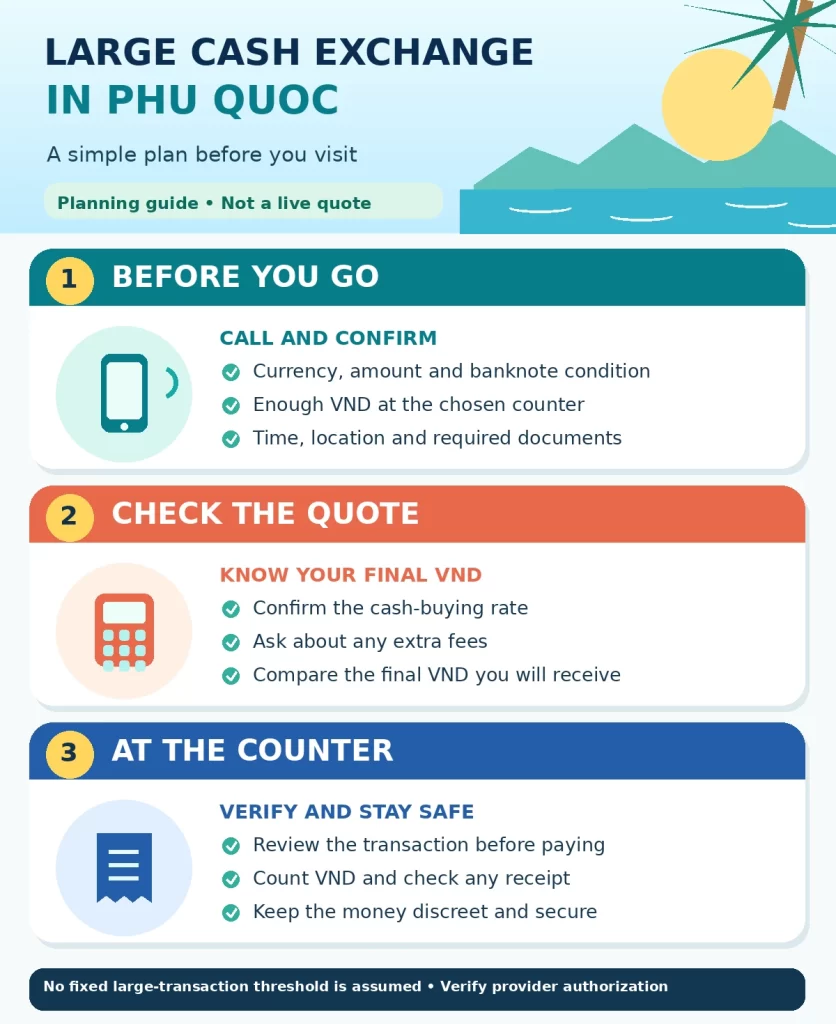
Quick answer: Confirm six things first: the currency and amount, accepted banknotes, current rate and any fees, final VND payout, VND availability, and the documents and time needed. Check the provider’s authorization rather than assuming a shop is permitted to exchange currency. For this website’s published service details, phone 0788 636 969 before travelling.
The site’s Currency Exchange Policy says larger or unusual exchanges may need advance confirmation. It does not publish a single amount at which every transaction becomes “large.” This is a practical visitor guide, not a promise that a particular exchange can be accepted.
What to prepare before contacting a counter
First, count what you actually hold. You do not need to travel with the banknotes just to ask a preliminary question.
| Information to prepare | Why the provider may ask |
|---|---|
| Currency and approximate total — for example, USD or EUR | The currency and size affect the quote and the amount of VND needed. |
| Number and value of notes — for example, how many 50s and 100s | Different denominations or note series may need different checks. |
| Condition — older, marked, stained or damaged notes | Not every physical note is necessarily accepted on the published terms. |
| Preferred counter, date and time | You need to confirm the exact place and whether staff can handle the transaction then. |
| Questions about identification | Documentation and transaction-information requirements may depend on the applicable procedure. |
If your notes are unusual, read the Banknote Guide first. HSBC Vietnam also explains that cash exchange terms may differ by note denomination or year and that quoted prices may not include every fee. See HSBC’s guidance.
Six questions to confirm before you travel
- Can this counter handle my currency and amount? Tell staff what foreign notes you hold, not just an approximate value in USD.
- Will you accept these banknotes? Mention old series, mixed denominations, marks, tears or other damage.
- Is enough VND available? A published exchange rate does not confirm cash inventory at a particular counter.
- What rate, fee and total VND apply? Ask for the cash-buying rate, separate charges or adjustments, and the expected amount paid out.
- What identification or transaction information should I bring? Confirm the applicable procedure; do not assume either that a passport is always needed or that no identification is needed.
- Which location and time are suitable? Verify the address, business hours and whether the amount can be processed within your planned visit.
Before travelling, use the current list of counters and Contact page. The published general hours are 08:00–22:00 daily, but they do not prove that a specific larger transaction is available right now.
A simple message you can use
Hello, I would like to exchange [currency] in cash, approximately [amount]. I have [number and denominations] of notes, including [any old or damaged notes]. Can you confirm whether the notes are accepted, whether sufficient VND is available, today’s cash-buying rate, any extra fees, the estimated final VND, what documents I need, and which counter and time I should visit?
This is a message template, not a reservation or guaranteed quote. Avoid sending scans of passports, bank details or other sensitive documents through an unverified message channel. Ask first how required information should be provided securely.
How to check the final VND amount
Do not judge an offer by the headline rate alone. If you are handing over foreign banknotes, ask for the rate at which the provider buys that foreign cash, not an unrelated selling or bank-transfer rate. Confirm the time the quote applies and whether any fee changes the payout.
Simple calculation: foreign-currency amount × cash-buying rate − any stated VND charges = VND received. If the rate is given for 100 units rather than 1, adjust the calculation. The rate comparison guide explains this with worked examples.
Compare like-for-like quotes at similar times, and check that the provider is properly authorized for the service you want. SeABank’s currency exchange guidance recommends banks or clearly authorized exchange agents, with current rates and transaction records. No statement here verifies the authorization of any particular Phu Quoc operator.
At the counter: verify the transaction before leaving
- Before handing over cash: reconfirm the currency, number of notes, applicable rate, any fees and the final VND.
- During the exchange: allow sufficient time for notes and money to be checked; do not rush a large count.
- Before leaving: check the VND you received discreetly, and compare any receipt or record with the amount, date, rate and provider details.
- If something differs: raise the discrepancy at the counter promptly and keep any applicable transaction record.
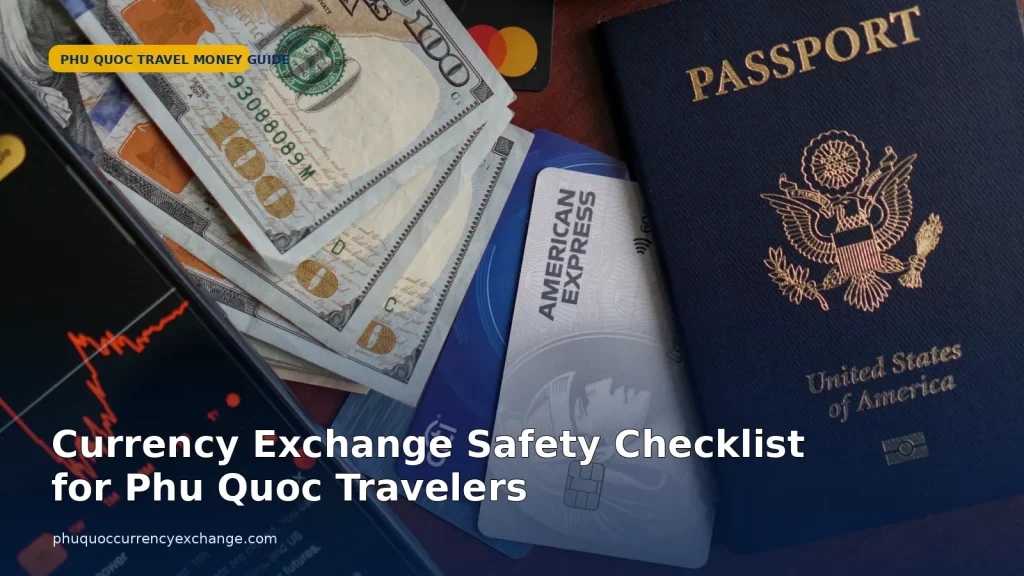
See the receipt checklist for a detailed record review and the Currency Exchange Safety Checklist for more steps before, during and after exchanging cash.
Cash safety and other rules to distinguish
Plan how you will carry and store the VND before arranging a larger exchange. Use a secure, discreet way to transport the funds, avoid displaying bundles in public, and do not carry more cash than your trip requires when suitable alternatives are available.
A counter’s decision to arrange a larger exchange is not the same as the legal rules for carrying cash across Vietnam’s international borders. Border customs declarations follow separate official requirements. Check the State Bank circular on international-border cash declarations and the traveler declaration guide if that applies to your journey. This article does not infer a transaction ceiling from those customs rules.
Should you use a bank, card or ATM instead?
If your money is already in a bank account rather than foreign banknotes, you may be able to pay by card or withdraw VND as needed instead of carrying a large bundle of foreign cash. Card issuers and ATM operators can charge fees and impose limits; do not assume that option is cheaper. Read Travel Card vs Cash Exchange and ATM vs Currency Exchange.
If you already hold physical foreign cash, compare what a bank and a verified exchange provider can actually offer for those notes. The bank vs exchange counter guide explains the practical differences without assuming a universal winner.
Final checklist and source notes
- Count and sort your banknotes by currency, value and condition.
- Confirm accepted notes, sufficient VND, current rate and all charges.
- Ask about required documents, timing and the precise counter.
- Choose a bank or exchange provider whose authorization you can verify.
- Plan safe transport, check the VND payout and retain relevant transaction records.
Source review: 25 October 2026. This article’s advice about advance confirmation is based on the website’s published exchange policy. Additional consumer guidance comes from HSBC Vietnam, SeABank and the Vietnam Trade Portal. Availability, fees, documentation and the operator’s authorization must be checked for your actual transaction; none are confirmed simply by this guide.