If your itinerary takes you through Ho Chi Minh City (Saigon) before Phu Quoc, you may be deciding whether to exchange foreign banknotes before your domestic flight or once you reach the island. Neither city is guaranteed to give a better rate. The right choice depends on your first VND payments, available time and the actual amount a provider will pay you.
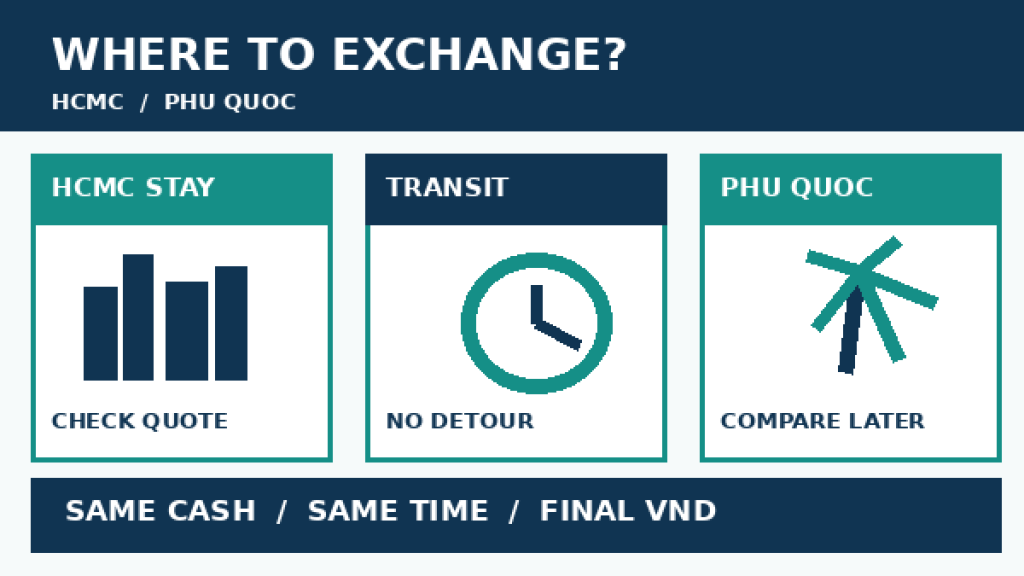
Quick answer: Already spending time in Ho Chi Minh City with a suitable verified quote? Exchanging enough for your next expenses can be convenient. Only changing flights, with a short connection? Do not make a special exchange detour that risks your flight. Going directly to Phu Quoc with a prepaid transfer or confirmed card option? You can compare local quotes after arrival. Compare final VND received, not city names or a rate from a different day.
Which city fits your itinerary?
Start with the payment you must make next, not with a claim about which destination has the best rate. A city may have many exchange options, but that does not prove any particular offer is suitable for your notes or your travel schedule.
| Your travel situation | Practical starting choice | Why |
|---|---|---|
| Staying in Ho Chi Minh City before the flight | Compare a provider along your existing route, and exchange what you will need soon if its current quote and terms work. | You have time to confirm a real offer without adding a rushed trip. |
| Short connection through Ho Chi Minh City | Prioritise the domestic flight and arrange your first Phu Quoc payment in advance where possible. | Baggage, terminal access and check-in time matter more than an unverified rate advantage. |
| Direct flight or prepaid island transfer | Travel to your accommodation first if no immediate VND payment is required, then compare island options. | You may not need to exchange all your cash at an airport. |
If your hotel transfer, first meal or deposit must be paid in VND, prepare a suitable initial amount. Vietnam Tourism’s official currency guidance explains why local cash remains useful for smaller purchases even though many established businesses accept cards. Individual card acceptance still needs confirmation.
Compare actual cash-buying quotes, not advertised city averages
If you hold USD, EUR, AUD or another foreign currency in cash, ask how much Vietnamese dong each provider would pay for those exact banknotes. For a fair comparison, both quotes need to refer to the same currency, quantity, denominations and similar time. A bank reference rate or an old travel-forum screenshot is not a confirmed exchange offer.
| Check | Question to ask |
|---|---|
| Cash-buying rate | How many VND will I receive for each unit of the foreign notes I am handing over? |
| Amount and notes | Does this quote apply to my currency, amount, series and note condition? |
| Fees | Are there separate charges, commissions or denomination adjustments? |
| Timing | When does this quote apply, and can the service process the transaction when I arrive? |
| Final VND | How much cash will I actually receive after all stated adjustments? |
Use the same-time currency exchange comparison guide for the full calculation. Confirm that the provider is authorised for the requested transaction rather than assuming a location listing, website or favourable rate proves authorisation.
Worked example: a better rate may not justify a detour
Imagine two hypothetical offers to buy your 200 USD in cash. One quotes 25,100 VND per USD, giving 5,020,000 VND before fees. The other quotes 25,140 VND per USD, giving 5,028,000 VND before fees. The difference is only 8,000 VND (200 × 40).
These figures are made up to explain the arithmetic, not real 2026 rates. If visiting the second provider requires extra transport, a fee or time you cannot spare, its higher headline rate may not improve your overall result. Ask for the final payout and consider the actual detour you would make; no universal Ho Chi Minh City versus Phu Quoc rate advantage follows from this example.
How much should you exchange before the flight?
Think in terms of cash needed until your next dependable cash stop, not the complete holiday budget. If a transfer is prepaid and your first purchases can be made by card, you may need less initial VND. If you will be paying cash immediately, allow for those confirmed costs and a personal backup amount.
The Phu Quoc working-cash guide shows how to estimate an amount based on your own itinerary, without treating sample figures as live local prices. If you want the broader choice between exchanging before arriving in Vietnam and doing it later, use Should You Exchange Money Before Arriving in Phu Quoc?.
What if your only convenient option is an airport?
Airport exchange can be useful when you need VND before your next journey, but availability and final rates must be checked at the actual service. Do not assume that an airport counter is open at your flight time, or that every international card will work at a particular ATM.
After landing in Phu Quoc, you can decide between an available airport service, an eligible ATM or comparing a provider along your hotel route. See Phu Quoc Airport Exchange: Airport vs Town for this specific arrival decision. Be cautious about adding a trip across town solely for a theoretical small rate difference.
A short checklist before exchanging
- Confirm your next payment. Do you truly need VND before reaching your hotel, or is transport already paid?
- Check the actual provider. Verify its location, opening and whether it can accept your cash currency and notes.
- Compare like for like. Ask for current cash-buying quotes, fees and final VND for the same amount.
- Protect your connection. Avoid a detour that risks domestic check-in or adds unexpected transport costs.
- Keep a fallback. A suitable card or sufficient VND can cover some first purchases, subject to acceptance; count your cash and keep any receipt.
If your banknotes are older, marked or unusual, check the Foreign Banknote Guide before planning the exchange. For choosing cash versus card when making purchases, use Cash or Card in Phu Quoc?.
Frequently asked questions and sources
Is the exchange rate always better in Ho Chi Minh City?
No. You need real cash-buying quotes for the same currency and notes at similar times. Do not treat a city average, another traveler’s experience or an old web rate as your offer.
Should I exchange all my travel money during a short transit?
Usually there is no reason to exchange the entire trip budget just because you are changing flights. Prioritise enough money for immediate cash payments, a working fallback and your connection time.
Can I pay by card instead of exchanging cash straight away?
Sometimes. Vietnam Tourism says many established businesses in Vietnam accept cards, while small sellers often use VND cash. Confirm the payment method with your actual provider; a merchant or ATM may offer optional home-currency conversion with a markup, as explained by Visa.
Sources checked 26 October 2026: Vietnam Tourism — Currency and Payments (cash and card use in Vietnam) and Visa — Dynamic Currency Conversion (optional card conversion disclosures). Neither source publishes a current side-by-side cash-buying rate for Ho Chi Minh City and Phu Quoc. The two rates in the example are hypothetical, and local provider availability, legal authorisation and rates must be checked for your transaction.