Currency exchange boards often show two rates for the same currency: We Buy and We Sell. The labels describe what the bank or exchange provider is doing, not what you are doing. That is the key to choosing the correct rate when changing foreign cash into Vietnamese dong (VND).
Quick answer: If you give USD, EUR or other foreign banknotes and receive VND, look for the provider’s Cash Buying / We Buy rate. If you give VND to receive foreign banknotes, look for the Selling / We Sell rate. Confirm that the provider offers that transaction and check the final amount before exchanging money.
Which rate should you use?
| You give | You receive | Which column? | Why? |
|---|---|---|---|
| USD cash | VND | We Buy USD (cash) | The provider buys your USD banknotes |
| EUR cash | VND | We Buy EUR (cash) | The provider buys your EUR banknotes |
| VND | USD cash | We Sell USD | The provider sells you USD banknotes |
| VND | EUR cash | We Sell EUR | The provider sells you EUR banknotes |
The common confusion is: “I am selling USD, so should I read Sell?” No — you are selling USD, but the provider is buying USD from you. Read the Buy column for the currency you hand over. Conversely, if you want USD banknotes, the provider is selling them to you.
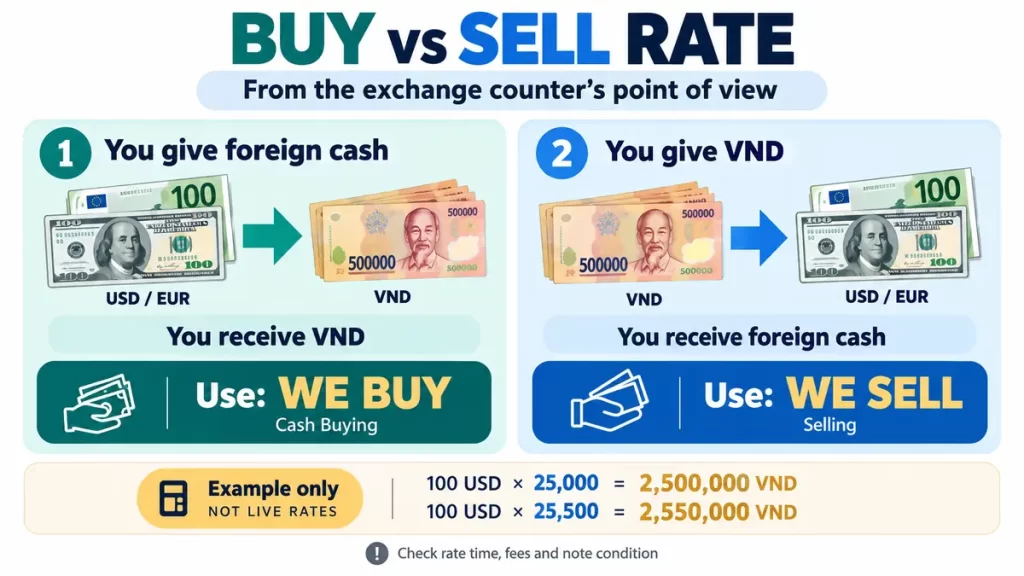
HSBC Vietnam gives the same explanation in its foreign exchange rate guide: use the bank’s buy rate when selling foreign currency for VND, and its sell rate when buying foreign currency with VND.
Example: exchanging 100 USD in either direction
Imagine a counter shows these made-up rates for USD banknotes: Cash Buying = 25,000 VND per USD and Selling = 25,500 VND per USD. These numbers teach the calculation; they are not live rates or quotes from any bank or exchange counter.
| Your situation | Rate used | Simple calculation |
|---|---|---|
| You hand over 100 USD and want VND | Cash Buying: 25,000 VND/USD | 100 × 25,000 = 2,500,000 VND received before separate fees |
| You want to receive 100 USD and pay VND | Selling: 25,500 VND/USD | 100 × 25,500 = 2,550,000 VND paid before separate fees |
If you have a fixed amount of VND and want to estimate the foreign cash you could receive, divide the VND amount by the Selling rate. For example, 2,550,000 ÷ 25,500 = 100 USD in this hypothetical example. Before planning a purchase of foreign cash, confirm the provider actually offers it and what conditions apply.
The difference between these two illustrative rates is 500 VND per USD. This difference is one way the buy–sell spread appears; it is not automatically a separate commission. See Exchange Rate Spread vs Fees for a fuller explanation.
Why do bank rate tables show three columns?
In Vietnam, a bank table may display Cash Buying, Telegraphic Buying (or Transfer Buying) and Selling. For example, Vietcombank’s exchange-rate table separates these categories.
- Cash Buying: the bank’s quoted buying rate for eligible foreign banknotes you bring to exchange for VND.
- Telegraphic/Transfer Buying: a rate for certain foreign-currency transfers, not automatically a quote for physical USD or EUR notes.
- Selling: a rate when the bank sells foreign currency to a customer, subject to the bank’s products, eligibility and transaction conditions.
If you are holding physical USD or EUR and want VND, do not choose a higher-looking Transfer Buying rate by mistake. The type of transaction matters just as much as the rate. Some currencies or physical notes may not have a published cash-buying quote, and a displayed selling rate does not confirm that you can buy that currency in cash at a particular branch.
Why are Buy and Sell rates different?
Exchange providers quote different buying and selling prices. The gap is called a spread. The spread may reflect currency-market prices and the provider’s operating costs, but you should still ask whether there is a separate fee, a denomination adjustment or another applicable charge.
A headline rate is not the final amount you can assume you will receive. If you compare two exchange offers, use the same foreign-cash amount and compare the final VND after all disclosed charges. Follow How to Compare Currency Exchange Rates in Phu Quoc for a worked comparison. Consumer advice from Australia’s ACCC also emphasizes checking the overall currency-exchange cost, not only a fee-free claim.
Check the rate, notes and counter before visiting
- Check the timestamp. Rates shown on an old screenshot, search snippet or social post may no longer apply. For a step-by-step guide, read Exchange Rate Timestamp: How to Check a Current Rate.
- Check your banknotes. Old, marked, torn, damaged or unusual notes may need separate review. Read the Banknote Guide.
- Confirm the direction. Say what you will give and what you want to receive, for example: “I have USD 100 cash and want VND.”
- Ask for the final amount. Confirm the applicable cash rate, any extra fee and the estimated VND received, then verify it at the counter.
- Confirm availability. A published rate is a reference, not a promise that any specific counter can process the transaction at that moment.
You can start with the site’s published exchange-rate table and Exchange Policy. For the correct location and transaction-specific confirmation, see current contact details. Avoid relying on an old address or unverified screenshot.
Frequently asked questions
I want to change USD cash into VND. Do I use Buy or Sell?
Use the Cash Buying / We Buy quote for USD, because the provider is buying your USD banknotes. Confirm any fees and the VND payout.
Is the Transfer Buying rate the same as Cash Buying?
Not necessarily. Transfer Buying generally applies to qualifying transfer transactions. For physical foreign notes, check the Cash Buying column and ask which terms apply.
Does the Selling rate mean I can buy USD cash anywhere?
No. Availability, customer eligibility and other conditions vary by provider. Ask whether the specific foreign-cash purchase is available before visiting.
Sources and review date
Reviewed 25 October 2026. The buy/sell direction follows HSBC Vietnam’s explanation; the three-column distinction follows Vietcombank’s official rate table. Rates and transaction terms vary over time. This guide explains how to read the board; it does not set a live exchange rate or confirm the legal authorization or current cash availability of an individual provider.