When you pay by card or withdraw cash at an ATM in Phu Quoc, a screen may offer to charge you in your home currency instead of Vietnamese dong (VND). This is called Dynamic Currency Conversion (DCC). It changes who converts the currency and which exchange rate is used.
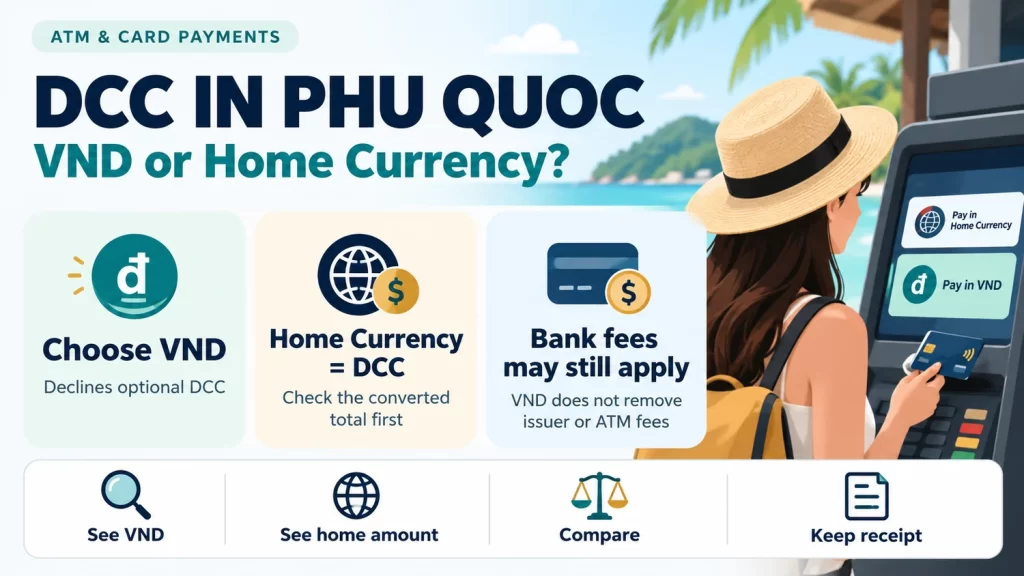
Quick answer: If you want to decline the ATM or shop’s optional currency conversion, choose VND (local currency) when that option is clearly shown. If you choose your home currency, check the displayed DCC rate, converted total and any markup first. Paying in VND can still involve fees from your own bank or card provider.
What does DCC actually change?
| Choice on the screen | Who usually converts the amount? | Costs to check |
|---|---|---|
| Pay in VND (local currency) | Your card network or card issuer, according to your card terms | Issuer exchange rate, foreign-transaction fee and any other applicable card charges |
| Pay in your card’s billing currency (DCC) | The ATM/merchant’s DCC provider | Displayed converted amount, DCC exchange rate and disclosed markup or additional charges |
The DCC provider’s markup may already be built into the rate and converted amount shown on the screen. Do not add the same markup a second time when comparing totals. Ask about a genuinely separate fee if the screen displays one. The actual final charge on your card also depends on your issuer’s terms.
Visa and Mastercard require the offer to give cardholders a genuine choice and disclose the relevant amounts and rate. See the Visa DCC guidance and Mastercard DCC Performance Guide.
Four checks before pressing a currency button
- 1. Find the local price. Note the purchase or withdrawal amount in VND.
- 2. Read the alternative. If the screen offers USD, EUR, AUD or your card’s billing currency, it may be offering DCC.
- 3. Check the cost. Look for the DCC exchange rate, markup and any separate fee. Compare with your own card’s known terms if possible.
- 4. Choose deliberately. Select VND to decline the optional DCC conversion, or accept the home-currency quote only after understanding its total cost.
Screens use different labels, such as local currency, without conversion or decline conversion. These do not always look alike. Read the explanation alongside the button. If you cannot tell whether a button only declines DCC or cancels the whole transaction, seek clarification or cancel safely instead of guessing.
Example: why the familiar amount may cost more
Imagine a hotel bill of 1,000,000 VND. The terminal offers to charge USD 42 using DCC. Your card provider’s route for the same VND purchase might work out to an estimated USD 40.50, including its known foreign-transaction fee. In that made-up example, DCC would cost USD 1.50 more.
These figures are hypothetical, not current Phu Quoc exchange rates or a guarantee of savings. Your provider’s eventual charge may differ because its rate and fees are governed by your card agreement and transaction timing. You may not know its final exchange amount at the terminal. The point is to compare the converted total and not decide from familiarity with the home-currency number alone.
DCC at an ATM versus a hotel or shop
At an ATM: You can withdraw VND and still be asked whether you want the ATM to convert the transaction into your billing currency. The ATM may charge a separate withdrawal surcharge, and your card issuer may charge an ATM fee. Declining DCC does not automatically remove those costs. For withdrawal limits, local ATM options and retained-card precautions, use the Phu Quoc ATM Guide.
At a hotel, restaurant or shop: A payment terminal may show the VND purchase and an amount in your home currency. The displayed home-currency amount can include DCC conversion pricing. Check what will be charged before tapping to confirm or letting staff complete the choice. The merchant should not decide your currency for you.
If you are still deciding whether to pay by card or carry VND cash, see Cash or Card in Phu Quoc?. For the separate question of using funds in an account or exchanging foreign banknotes, read Travel Card vs Cash Exchange.
What if DCC was applied without your consent?
- Before you approve: if the rates or choices are missing or unclear, do not accept a conversion you do not understand. Visa recommends declining a DCC offer when the required information is missing or the choice feels pressured.
- Before a transaction is final: ask to return to the currency-choice screen or have staff clarify the options. Do not assume a completed charge can be instantly reversed.
- After the charge: keep the receipt or ATM record and the transaction date, amount and currency. Compare them with the card statement when posted.
- If you did not choose DCC: contact your card issuer promptly and explain the missing or unauthorized choice. The issuer can advise whether a transaction dispute is possible; a refund is not automatic.
The Mastercard guide describes cardholder consent and routes for handling incorrectly applied DCC. The Visa consumer guide explains what information should be shown and when to report an issue.
Check the receipt and avoid fee confusion
Before leaving, verify the currency selected, local VND amount, converted total (if applicable), rate and any disclosed DCC charge. Save your record until the card transaction appears on your statement.
Three charges often get mixed up: DCC conversion markup (linked to accepting the merchant/ATM conversion), ATM operator surcharge (a withdrawal fee that can exist without DCC), and issuer fees (under your own card agreement). For more on rate spreads and fees, read Exchange Rate Spread vs Fees.
Frequently asked questions
Is paying in VND always cheaper?
No. VND declines the optional merchant or ATM DCC conversion, but your own bank or card provider can still use an exchange rate and charge foreign-transaction fees. Check the relevant terms.
Does declining DCC cancel an ATM surcharge?
No. A cash-machine operator fee is separate from the DCC choice. Your card provider may also charge for withdrawals.
Can the cashier choose the currency for me?
The card-network guidance cited here requires a genuine cardholder choice. Ask to review the currency options yourself before the transaction is completed.
Sources and review date
Reviewed 25 October 2026. The Visa DCC travel guidance describes screen disclosures and the right to decline; the Mastercard 2025 DCC Performance Guide explains consent, neutral presentation and the exchange-rate terms. Terminal wording, issuer fees and effective exchange rates vary. This article is an explanation of card-payment choices, not a live rate quotation or a claim that one route always costs less.