An exchange rate can change after it is published. Before exchanging foreign banknotes for Vietnamese dong (VND) in Phu Quoc, check when the rate was updated, whose rate it is and whether it is a reference or an actual cash-exchange quote. A new-looking page or a screenshot is not enough.
Quick answer: Open the original rate source, find the date and time attached to the rate data, check the currency and buying/selling direction, then confirm the rate and final VND with the provider before completing a transaction. A timestamp records an update; it is not a guarantee that the rate will stay available for the rest of the day.
What does an exchange-rate timestamp tell you?
A label such as “Rate updated” or “Bank updated” describes the time associated with the published data. It does not mean the exchange counter is open, has VND available, accepts your exact banknotes or promises to use that rate.
If the page was updated this morning but you plan to exchange later, check again closer to your visit. There is no universal rule that a rate becomes “expired” after 15 minutes, one hour or one day. The source may update on its own schedule, and transactions may be confirmed separately.
A real timestamp example from Vietcombank
In a dated example recorded from the official Vietcombank exchange-rate page, its rate board displayed “Exchange rate updated at 23:00 on 25/10/2026.” That means the bank published that set of rates with a stated update time on 25 October 2026. It does not mean those rates are still current when you read this guide, nor that a Phu Quoc counter will honor them.
Vietcombank also separates Cash Buying, Telegraphic Buying and Selling, and labels the bank’s figures as reference information. If you are giving physical USD or EUR notes and receiving VND, a cash-buying rate is the relevant direction to ask about; a bank reference is not automatically the price offered by another provider. See Buy vs Sell Exchange Rates for the terms.
When a rate board displays a timezone, read it along with the date and clock time. If the page converts a server time to local time, make sure you are not comparing UTC with Vietnam time as if they were the same.
Three different times that can appear on one website
| Time label | What it actually tells you |
|---|---|
| Bank / source updated | When the bank or rate data source last reported or published the displayed values. |
| Page refreshed / fetched | When a website or your browser last requested or displayed the information. New fetch time does not prove the underlying bank rate changed. |
| Article last updated | When a guide or webpage’s editorial text changed. It is not the currency rate’s data timestamp. |
For example, a rate widget may be loaded at 09:00 while displaying bank data marked 23:00 the previous night. The bank-data time is the one to use when judging how recent those values are. Likewise, a guide updated today could still contain an older rate example.
Google Search Central’s publication-date guidance describes a page’s editorial publish/modify date; it should not be confused with a continuously changing currency feed. Keep the three meanings separate.
Reference rates, published board rates and the final cash quote
| Kind of rate | How to use it |
|---|---|
| Bank or central-bank reference | Background comparison only; check its source timestamp and rate type. |
| Rate published on a service website | Useful starting point; check the actual label, currency, direction, time and any disclaimer. |
| Final rate confirmed for your transaction | Used to understand the actual VND you will receive, including any applicable charges and accepted banknotes. |
The European Central Bank’s euro reference rates are published for information, and the ECB discourages using them as transaction rates. Vietcombank similarly marks its published rate information as reference material. Neither reference creates a guaranteed walk-in cash quote from a separate exchange business.
For full comparisons between two providers’ cash offers, use How to Compare Currency Exchange Rates in Phu Quoc. This article stays focused on the age and meaning of the timestamp, not negotiating or ranking providers.
How to check the current rate before visiting
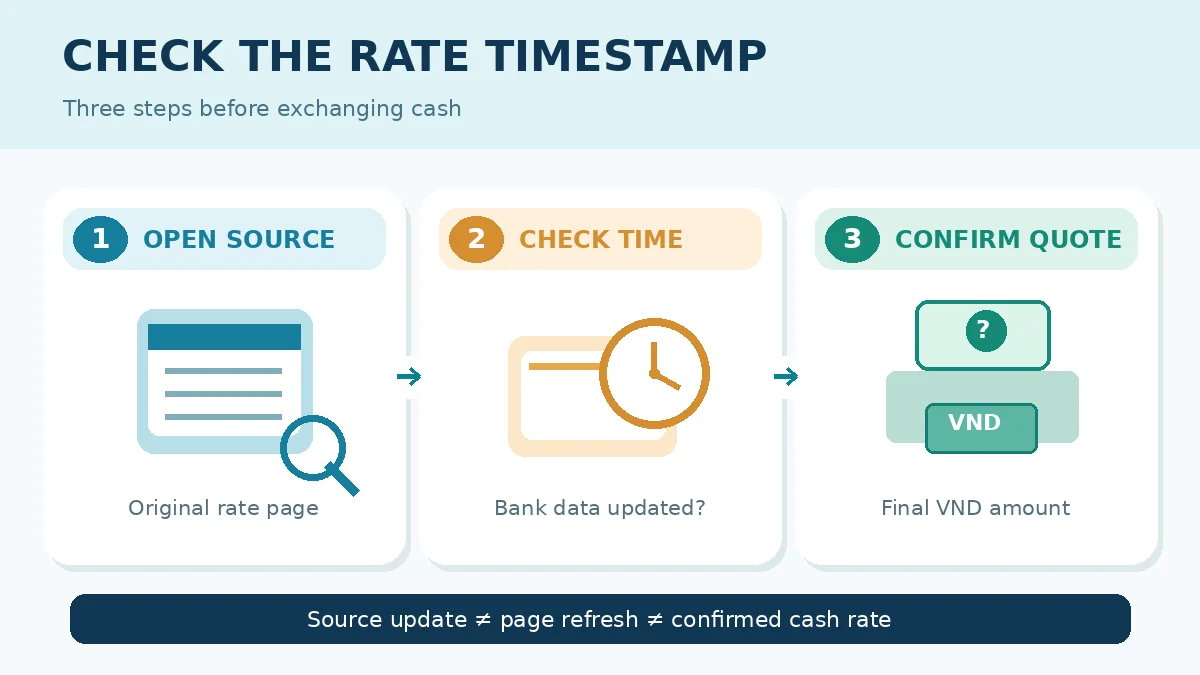
- Open the original page. Go to the site’s published exchange-rate board rather than relying on a screenshot, social post or search snippet.
- Read the exact data time. Look for “Bank updated,” “Last updated” or “As of” with the date, time and timezone if shown. Do not substitute the article publish date or your device’s current time.
- Identify the source and direction. Is the table a bank reference, a provider-published rate or a cash quote? If you give foreign notes for VND, ask for the correct cash-buying direction.
- Refresh near your planned visit. If the rate is important or has an unclear timestamp, check again before traveling and ask about the actual note series and condition.
- Confirm the final transaction. Use the current contact information to ask the exact rate, accepted cash amount, any fee and the VND you will receive. No published board is a permanent price commitment.
For example, you can ask: “I have [currency] [amount] in cash and plan to visit [date/time]. What is your current cash-buying rate, are these banknotes accepted, and how much VND would I receive after any charges?” Do not send sensitive ID documents through an unverified contact.
What if a screenshot, search result or two pages disagree?
- Screenshot with no date: treat it as historical or unverified; open the original source.
- Search result dated today: the search result’s date may concern the webpage, not the underlying bank rate.
- Different quotes: check the two source timestamps, exchange direction, currency unit and reference-vs-service label before comparing.
- Time displayed but no timezone: do not assume you know the source’s local clock; confirm if timing matters.
- No timestamp visible: mark data freshness as unknown, not automatically false or current, and confirm directly.
A posted number that changes after your check is not necessarily evidence the earlier update was inaccurate. Rate data can legitimately be revised. If you are about to exchange a large amount, reconfirm the final rate and use the Currency Exchange Safety Checklist for the rest of the transaction.
Frequently asked questions
Is a rate marked ‘today’ guaranteed until closing?
No. “Today” does not promise that the displayed rate will apply for the full day. Ask for the current cash quote at the time of exchange.
Does ‘page refreshed just now’ mean the bank just updated its rates?
Not necessarily. A page can load or refresh an older published data record. Check the source or bank update timestamp rather than page-load time.
Can I use yesterday’s screenshot to demand that rate?
A screenshot is evidence of what someone captured earlier, not automatically an offer or a guaranteed rate for a later cash transaction.
What if the rate table has no timestamp?
Treat its freshness as unverified, read the source and disclaimers and confirm directly before relying on it.
Sources reviewed 26 October 2026: Vietcombank exchange rates, ECB euro reference rates and Google’s publication-date guidance. The 25 October timestamp above is a dated example, not a claim about live current rates, available cash, or any particular provider’s authorization. For pricing structure rather than timing, read Exchange Rate Spread vs Fees.