A currency exchange receipt helps you check how much foreign cash you exchanged and how much Vietnamese dong (VND) you received. It can also help if an amount is wrong or you need proof of an earlier exchange for a specific procedure.
Quick answer: Ask for the appropriate transaction record, check the currency, amount, rate, any fee and final VND, and count your cash before leaving. Keep the record until your trip, any complaint and any planned exchange-back decision are complete.
The exact document might be called a receipt, invoice or transaction record. Not every provider uses the same format. For the whole exchange process, see How to Exchange Money in Phu Quoc.
What to check on a currency exchange receipt
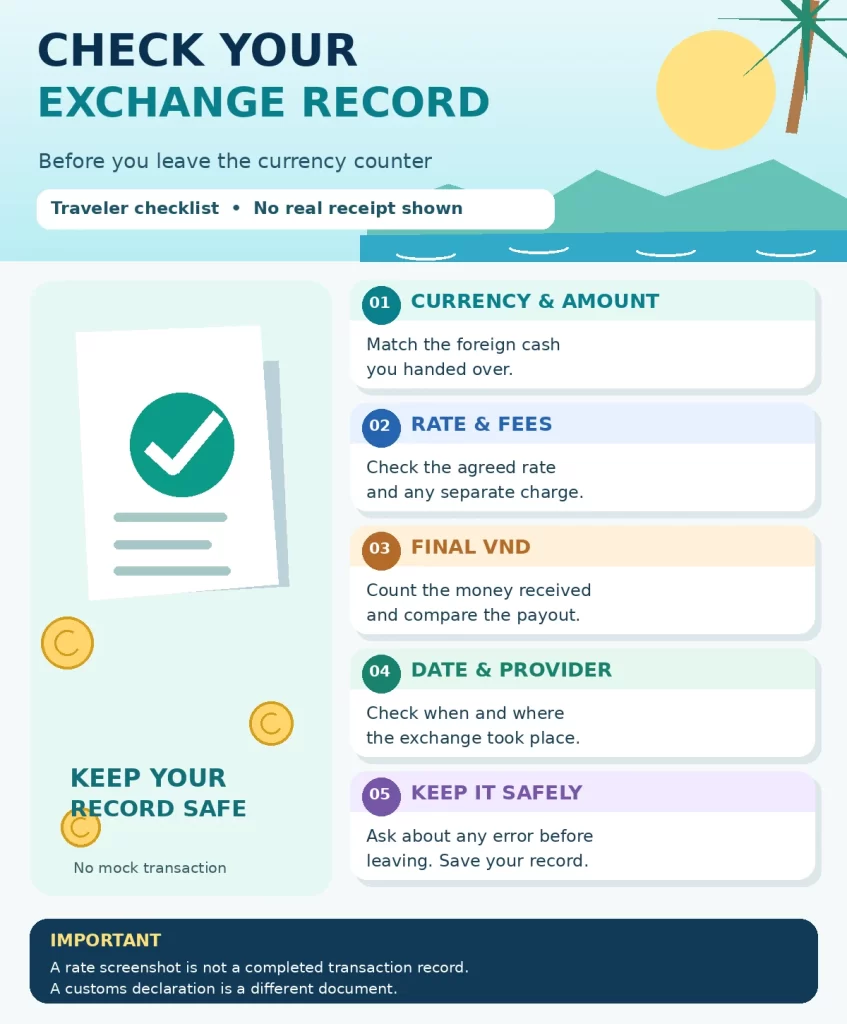
Use the following quick check on the document you receive. If a field is missing or unclear, ask the provider how to verify that part of your transaction.
| Detail | Check against |
|---|---|
| Foreign currency and amount | The banknotes you handed over and the amount accepted |
| Exchange rate | The rate agreed for this transaction, not an old online screenshot |
| Fee or adjustment | Any separate charge explained before the exchange |
| Final VND | The amount you actually received and counted |
| Date and provider | When and where the transaction took place |
Take time to count or verify the VND while still at the counter. A correct-looking receipt is not a substitute for checking the banknotes received. For information about website quote timestamps, see the Exchange Rate Timestamp Guide.
What if the rate, receipt or cash amount is wrong?
- Check the foreign amount. Compare the recorded currency and amount with the notes accepted.
- Check the agreed rate. Make sure it is the rate for the transaction you completed.
- Check any fee. Ask for an explanation of a charge or banknote adjustment you did not expect.
- Recalculate final VND. Compare the expected payout with the cash you counted.
- Ask for a correction before leaving. Identify the exact mismatch and keep the record and any relevant response.
For example, if the foreign amount is correct but the VND amount is lower, ask whether the agreed rate or a separate fee explains the difference. If the printed amount is correct but the cash count differs, raise that issue immediately. Each case needs a different check.
How long should a traveler keep the receipt?
For an ordinary trip, a practical approach is to keep the original until after departure, until any transaction questions are settled, and until you have decided what to do with leftover VND. A bank or other specific process may require it for longer; check the relevant requirement before discarding it.
A 90-day rule does not apply to every exchange receipt. One narrow border-area procedure described below uses that period; it is not a universal traveler retention deadline.
Keep the original dry and legible. You can make a clear photo as a backup, store it securely and protect personal details. A photo may not replace an original if the applicable procedure requires the original.
When might a receipt matter before leaving Vietnam?
A State Bank of Vietnam national risk assessment discusses a special foreign-currency repurchase situation at exchange agents in international border-gate isolation areas. In that situation, amounts above USD 1,000 or equivalent may require a passport and a receipt proving an earlier exchange. The earlier receipt has a described 90-day validity period for that specific repurchase procedure.
This does not mean every currency exchange counter can change leftover VND back into foreign currency or that every receipt expires after 90 days. Confirm the current rules and whether the particular service exists before travelling. See Leftover Vietnamese Dong for general end-of-trip planning.
Receipt, rate screenshot and customs declaration are different
| Document | What it proves |
|---|---|
| Exchange receipt or invoice | Details of a completed exchange transaction |
| Rate screenshot | What a website displayed at one moment, not necessarily your completed rate |
| Customs declaration | Cash carried across an international border where declaration is required |
A customs declaration is not an exchange receipt. If you brought a larger amount of cash into Vietnam, you may need to keep both documents for different purposes. Read Bringing Cash Into Vietnam for the border topic.
Does Vietnamese law require exchange records?
Circular 75/2025/TT-NHNN, effective 31 December 2025, addresses the operating procedures included in a foreign-exchange agent registration file. These procedures cover recording transactions, issuing customer invoices and keeping documents and accounting records.
This does not show that all businesses use one receipt design or that any specific operator listed on this website has verified authorization. Travelers should check a provider’s status and request the appropriate record. HSBC Vietnam recommends keeping exchange receipts. SeABank advises asking for a receipt or invoice.
Five checks before leaving the counter
- The foreign currency and amount are correct.
- The exchange rate and any additional fee are understood.
- The final VND has been counted and matches the agreed transaction.
- The date and provider details identify the transaction.
- Any question has been raised and the record stored safely.
For larger transactions, use these steps with Exchanging a Larger Amount of Cash in Phu Quoc. This is a traveler checklist, not a sample receipt from a real transaction.
Sources and limits of this guide
Reviewed 25 October 2026. Legal information was checked against the Vietnamese legal database and the State Bank risk assessment. The repurchase example has narrow border-area conditions. Actual invoice practices, proof requirements and services vary. No anonymized, verified first-party receipt has been supplied for this page, so none is shown as factual evidence.