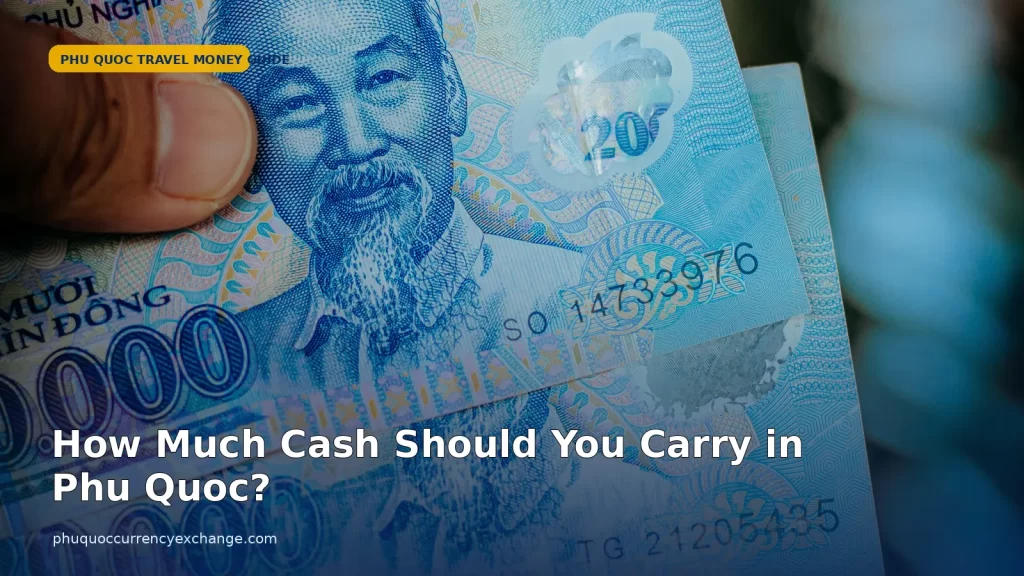
There is no single correct cash amount for every Phu Quoc traveler. A resort guest with prepaid transfers, a mixed cash-and-card traveler and someone spending heavily at small local businesses can all need very different amounts. The useful method is to calculate working cash from your own itinerary, then keep a replenishment plan instead of carrying the full trip budget at once.
Planning formula: working cash = cash-only expenses + uncertain expenses + personal buffer.
Important: the numerical examples below are hypothetical planning examples, not claims about current Phu Quoc prices and not recommended budgets for every traveler.
Last source check: 21 September 2026. Vietnam Tourism notes that cash remains common for smaller purchases while many established businesses accept major cards. Actual merchant acceptance and card fees still need to be checked for the places you plan to use.
Step 1: remove everything already paid
Start with accommodation, flights, transfers, tours and activities that are already prepaid. Do not count them again in the cash you carry. Then list only the costs that remain during the period before your next reliable ATM, card payment or exchange opportunity.
- Meals not included in your booking
- Local transport that may require cash
- Markets and small purchases
- Small admissions or activities not prepaid
- Optional tips where appropriate
- A personal contingency buffer
Step 2: separate cash-only, card-friendly and uncertain expenses
Cash-only or cash-preferred
These are payments where you already know cash will be required or where you prefer cash for practical reasons.
Card-friendly
These are payments you have confirmed can be made by card. Do not convert cash for them automatically, especially if your card terms are reasonable.
Uncertain
If you are not sure whether a merchant, driver or activity accepts your card, treat that expense as uncertain until you confirm. The Cash or Card in Phu Quoc? guide helps you plan this mix.
Step 3: choose a personal buffer
A buffer protects against small changes in the day: a card terminal not working, a route change or an extra cash payment. It should be based on your own comfort and access to backup payment methods. A buffer is not a reason to carry the whole holiday budget in cash.
Three planning scenarios
These examples use invented numbers only to demonstrate the calculation. Replace every number with your own expected expenses.
Scenario A: resort or mostly prepaid traveler
- Cash-only expenses you expect before replenishing: 300,000 VND
- Uncertain expenses: 200,000 VND
- Personal buffer: 200,000 VND
Illustrative working cash: 700,000 VND. This is not a Phu Quoc price recommendation; it is simply 300,000 + 200,000 + 200,000 using hypothetical inputs.
Scenario B: mixed cash-and-card traveler
- Cash-only expenses: 600,000 VND
- Uncertain expenses: 400,000 VND
- Personal buffer: 300,000 VND
Illustrative working cash: 1,300,000 VND. Replace the three inputs with your own itinerary numbers.
Scenario C: cash-heavy local-market day
- Cash-only expenses: 1,200,000 VND
- Uncertain expenses: 600,000 VND
- Personal buffer: 400,000 VND
Illustrative working cash: 2,200,000 VND. The point is the method, not the number. If your real itinerary produces lower or higher inputs, your working cash should change with them.
Step 4: build a replenishment route
A cash plan is safer when you know how you would obtain more VND. If ATMs are part of the plan, review the Phu Quoc ATM guide for local ATM leads, operator fees, withdrawal limits and DCC. If you carry foreign cash, confirm accepted currencies and banknote conditions before making a special trip.
Published local exchange fallback
This service currently publishes three exchange counters: one in An Thới and two in Dương Đông. Published hours are 08:00–22:00 daily and the public phone is 0788 636 969. Confirm the current rate, counter and transaction availability before traveling, especially for a larger amount.
- An Thới: Căn AT96 Đại Lộ New An Thới, Tổ 10, Kp6 An Thới.
- Dương Đông: Số 12 Nguyễn An Ninh, Kp2 Dương Đông.
- Dương Đông: Số 124 Trần Hưng Đạo, Kp7 Dương Đông.
Step 5: reduce the target near departure
Your cash target should fall as the trip gets shorter. Before another withdrawal or exchange during the final day or two, subtract the expenses you are still likely to pay in cash. If your remaining VND already covers them, another transaction may create unnecessary leftover money.
For the departure workflow, read What to Do With Leftover Vietnamese Dong Before Leaving Phu Quoc.
Do not confuse a currency converter with a travel budget
A converter can show what an amount is worth at a stated exchange rate. It cannot know how much cash your itinerary needs. Decide the working-cash amount first, then compare the rate and transaction costs for obtaining that amount.
Cash-planning checklist
- Remove prepaid expenses.
- List cash-only expenses.
- List uncertain expenses.
- Add a personal buffer.
- Keep a backup payment method separately.
- Know where you can obtain more VND.
- Check ATM operator and issuer fees before relying on withdrawals.
- Confirm larger exchanges before traveling to a counter.
- Reduce new cash transactions as departure approaches.
Official context and next guides
Vietnam Tourism’s currency guidance identifies VND as Vietnam’s official currency, notes that cash is commonly used for smaller purchases and says many established businesses accept major cards. That national guidance is a planning baseline, not a guarantee that a specific Phu Quoc merchant accepts your card.
- Vietnam Tourism — Currency and payments in Vietnam
- Vietnamese Dong Guide
- Phu Quoc Travel Money Guide
- Contact and current service details
Freshness note: the scenario numbers above are deliberately illustrative and should not be reused as “average daily spend” claims. Recalculate from your own itinerary, current payment acceptance and current transaction fees.