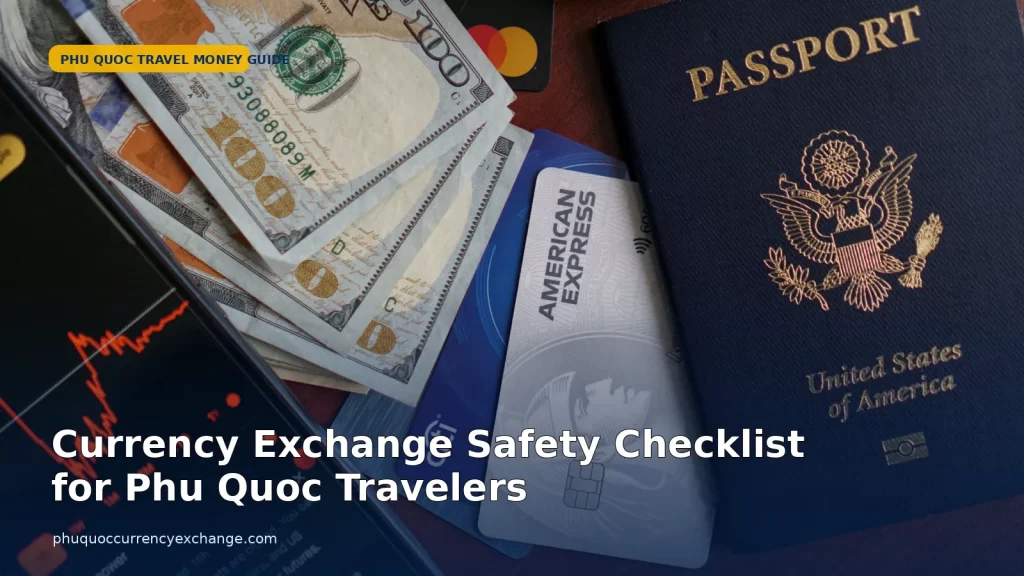
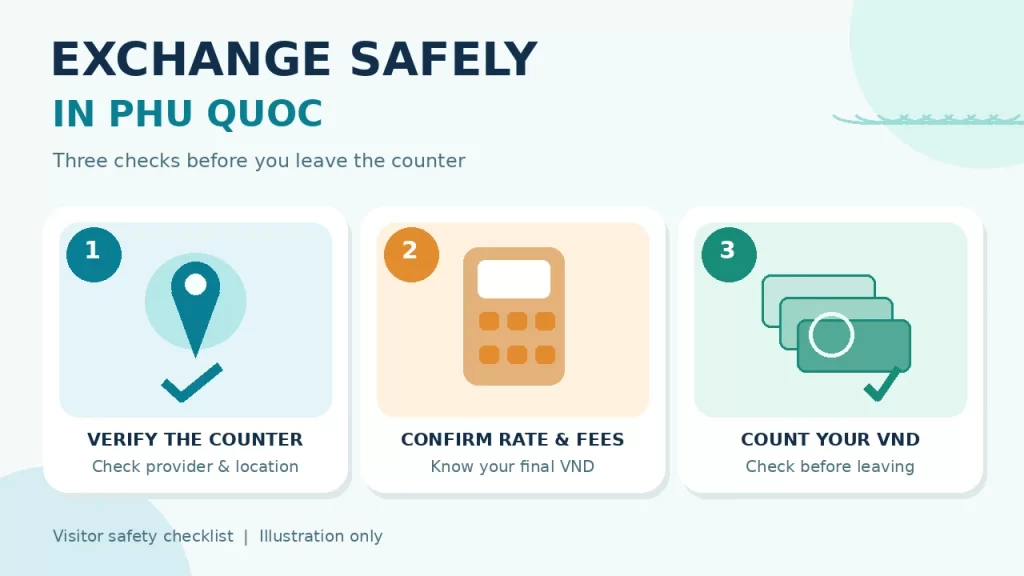
Before exchanging foreign cash in Phu Quoc, check who provides the service, where you are going, what VND you will receive and whether the final cash count matches. It is easier to clarify a mistake before you leave the counter.
Quick safety check: verify the provider and current location, agree on the cash-buying rate and any fees, count your banknotes, check the final VND and keep a transaction record. Pause if the details are unclear.
For the full exchange sequence, see How to Exchange Money in Phu Quoc. This guide focuses on practical safety, not a guarantee of any individual operator’s authorization.
1. Verify the provider
Check the business identity and whether the bank or exchange agent is permitted to provide this service. A company registration, website, map review or good-looking rate does not itself prove permission to exchange foreign currency. Vietnam’s National Public Service Portal lists separate authorization conditions, including an authorizing bank and information displayed at the agent.
The site’s Business Information provides published identity details. Read How to Check an Authorized Exchange Provider for the licensing question; do not treat this website as independent proof that a particular counter is authorized.
2. Confirm the current counter location
A map pin or forwarded screenshot can be outdated. Use the site’s current Exchange Counters list for the branch address and directions, rather than relying on an old street address copied into a guide.
Before carrying a large amount of cash, confirm the location and service through current contact details or call 0788 636 969. Published opening hours do not guarantee that enough VND is available for your particular transaction.
3. Agree on the transaction terms first
- Which rate? If you hand over USD or EUR notes and receive VND, ask for the cash-buying rate; see Buy vs Sell Exchange Rates.
- What total? Ask how much VND you will get after any fee or adjustment, not just the rate on a sign.
- Which notes? Confirm whether your denominations and any old, damaged or marked notes are accepted. See the Banknote Guide.
- What documents? Ask what identification is required for the actual transaction. Never send passport scans to an unverified personal account or link.
For larger amounts, confirm the date, cash availability and exact conditions beforehand in Exchanging a Larger Amount of Cash in Phu Quoc. October 2026 reporting of State Bank advice recommends using authorized providers and checking the quote.
4. Count the notes and watch for red flags
Count foreign notes by denomination before handing them over, and check the amount accepted. Before leaving, count the VND received and compare it with the expected payout. If you receive a receipt or transaction record, check it; see the receipt checklist.
| Situation | What to do |
|---|---|
| The rate, fee or accepted amount changes without explanation | Pause and reconfirm the total before agreeing. |
| The count of accepted foreign banknotes differs from yours | Ask to recount the notes together. |
| Someone redirects you to an unverified address or private meeting | Do not hand over cash; verify the counter through its official channel. |
| You are rushed to leave without counting VND, or asked for sensitive documents through an unknown link | Stop and request a clear procedure; move away safely if pressured. |
5. What if the final amount does not match?
- Count the VND again by denomination while still at the counter, if safe.
- Check the foreign notes accepted, agreed rate and any fee.
- Ask the provider for an explanation or correction, and keep relevant transaction details.
- If necessary, use verified contact details to raise a complaint. If you feel threatened or suspect theft, move to safety and seek local help.
For emergencies, Vietnam’s police number is 113. The UK government’s travel advice notes that emergency services work in Vietnamese and recommends obtaining a police report when reporting a crime. A counting difference on its own does not prove wrongdoing.
6. Keep money and documents safe
For a large exchange, call ahead, carry only the cash needed and avoid showing bundles of notes in public. Keep another payment option separately and protect your valuables in crowded places. Vietnam Tourism advises travellers to keep cash and belongings secure.
Share personal documents only through a verified provider’s legitimate process when required. For the ID question, see the Passport and ID Guide.
7. Before, during and after
| Situation | What to do |
|---|---|
| Before | Verify the provider, branch, current rate, fees and acceptable notes. |
| During | Know your foreign-note count and confirm any changed terms. |
| After | Count VND, check any record and secure the cash. |
8. Sources and important limits
Reviewed 25 October 2026. The National Public Service Portal describes exchange-agent authorization; Vietnam Tourism provides travel safety guidance. Verify actual provider authorization, rates, branch locations, hours and cash availability independently. A business-registration page, illustration or older map listing is not proof of licensing or live service.